Can your compact car tow a trailer legally and without exceeding its limits? When choosing a mini-trailer for your vehicle, the answer doesn’t depend on the make of the car, but on three numbers: its towing capacity, its net mass and the real weight of the trailer once loaded.
Good news for your next vacation: the two ultralight mini-trailers mentioned below weigh 220 and 405 kg empty. At that weight, you don’t need a pickup truck to hit the road. All it takes is a vehicle that respects the capacity set by its manufacturer and Quebec’s rule on trailer brakes.
Choosing a mini-trailer for your vehicle in three numbers
Three figures decide compatibility, and none of them is on the trailer’s spec sheet. The towing capacity and the tongue weight limit are in the towing section of the owner’s manual. The payload, meaning the maximum weight of occupants and cargo combined, is printed on the label on the driver’s door pillar. Tongue weight counts toward that payload, just like passengers.
Towing capacity
Towing capacity is the maximum weight, loaded trailer included, that the vehicle can tow. It sometimes changes from one version of the same model to another. According to Protégez-Vous, a Ford Explorer with a 4-cylinder engine can tow 1,360 kg (3,000 lb), compared with 2,540 kg (5,600 lb) with the V6. The same guide puts the capacity of small SUVs at 680 kg (1,500 lb).
Some vehicles, especially small cars, aren’t approved for towing. In that case, no trailer is an option, not even an ultralight one.
Tongue weight
Tongue weight is the load the front of the trailer puts on the hitch ball. Too low, and the combination becomes unstable at high speed. Too high, and it compresses the vehicle’s rear suspension and lightens the front axle, which affects steering and braking.
To stay under the manufacturer’s limit, place heavy items (cooler, battery, water) over the trailer’s axle rather than at the front. On a light trailer, a bathroom scale slipped under the front jack, with the tongue at hitch height, gives a good estimate of tongue weight.
Net mass and Quebec’s brake rule
The Highway Safety Code requires an independent braking system on each load-bearing wheel of the trailer in two cases, as summarized in the École nationale de police du Québec quick-reference guide: when the trailer’s mass, load included, reaches 1,300 kg or more, or when it exceeds half the net mass of the vehicle towing it.
This second criterion matters most for a small vehicle. A trailer loaded to 300 kg requires a vehicle with a net mass of at least 600 kg to travel without trailer brakes. A trailer loaded to 500 kg requires at least 1,000 kg.
Calculating the trailer’s real loaded weight
The weight a manufacturer advertises is almost always a dry weight. On the road, the trailer also carries mattresses, dishes, a cooler, water bottles, and sometimes an extra battery or a generator. Each litre of water weighs 1 kg: two 20-litre jugs alone add 40 kg.
Add up the weight of everything you plan to bring, weighing the biggest items on a bathroom scale if needed, then compare the total with the vehicle’s towing capacity. Also check the vehicle’s payload: the passengers, the luggage in the trunk and the tongue weight all have to fit within it.
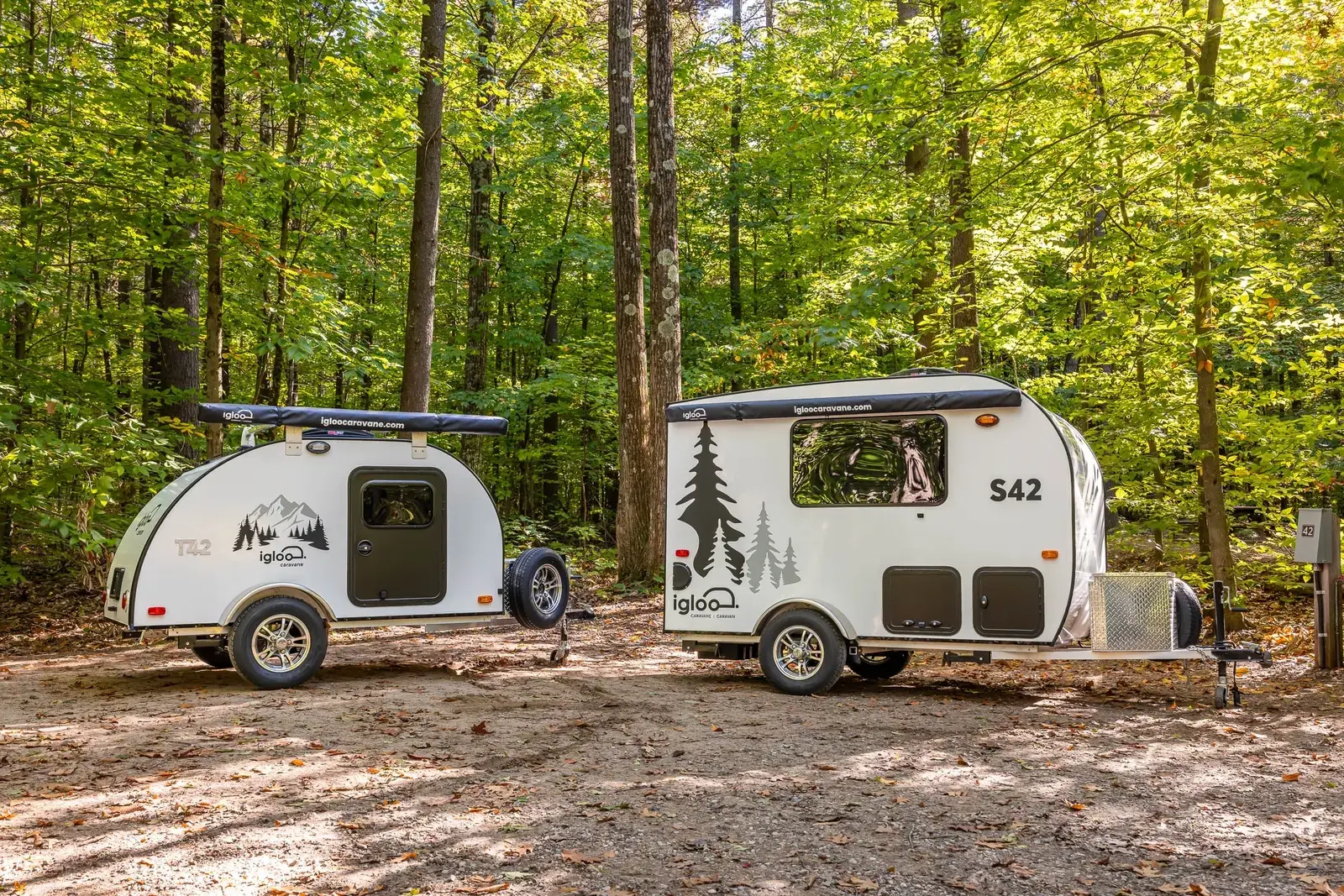
Two light trailers built in Quebec give a sense of scale. The T42 mini-trailer has a net weight of 485 lb (220 kg). The S42 mini-trailer, which lets you stand up inside, weighs 885 lb (405 kg).
Which mini-trailer format for which type of vehicle
| Vehicle type | What to check first | Best-suited format |
|---|---|---|
| Sedan or compact car | Whether towing is allowed, often modest capacity | Teardrop-style mini-trailer under 300 kg loaded |
| Small SUV or crossover | Capacity around 680 kg according to Protégez-Vous, tongue weight | Teardrop or stand-up mini-trailer under 500 kg loaded |
| Mid-size SUV or pickup truck | Payload, factory-installed hitch or not | Any mini-trailer format, with a comfortable margin |
| Electric vehicle | Approved capacity and effect on range | The lightest and lowest format possible |
Sedan or compact car
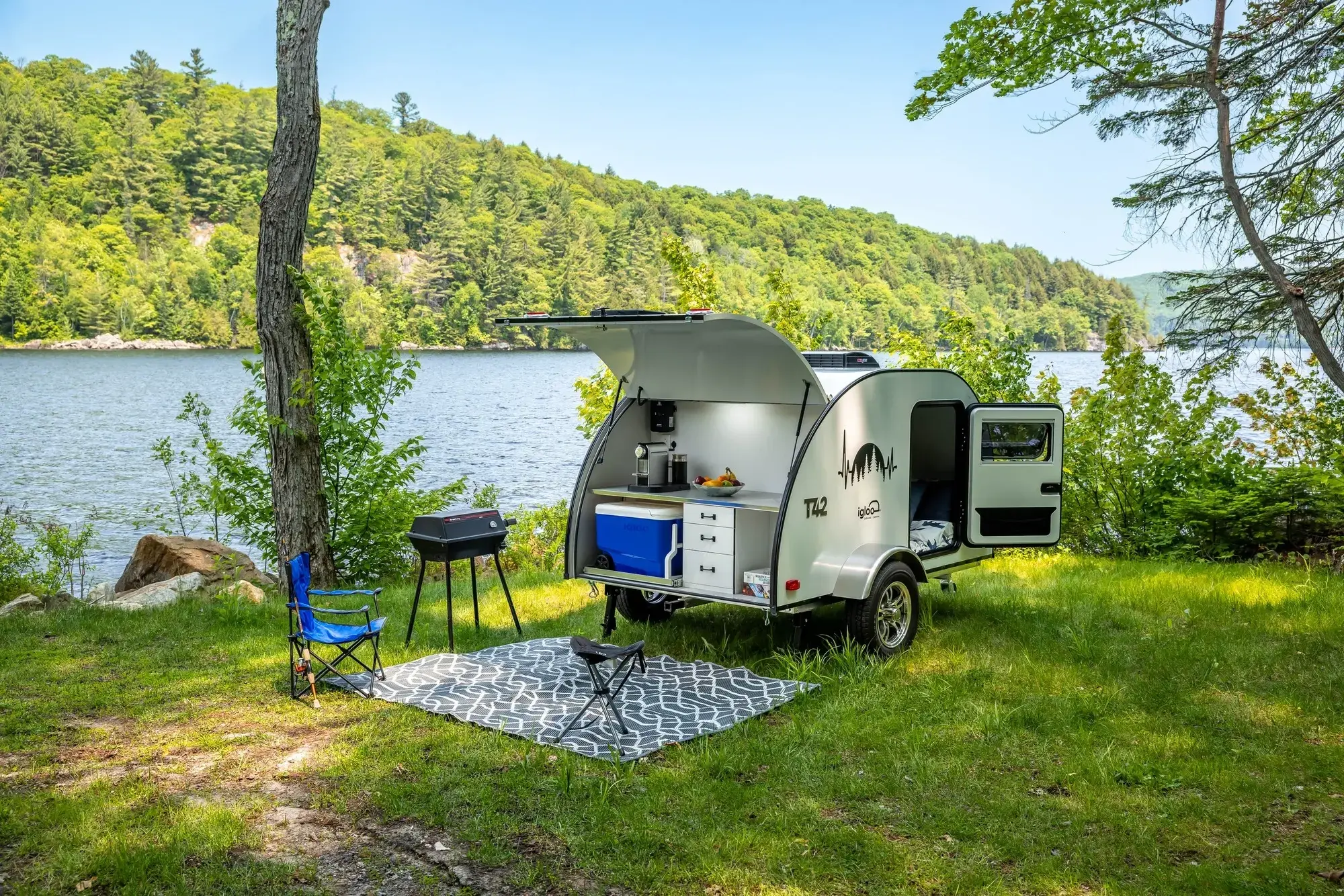
For a sedan, lightness is the priority. A teardrop format, where you sleep inside and cook under the rear hatch, can keep the loaded weight around 300 kg. Most sedans have a net mass well over twice that figure, which keeps you within the brake rule. Enough to go camping by a lake on Friday night without changing cars.
Small SUV or crossover
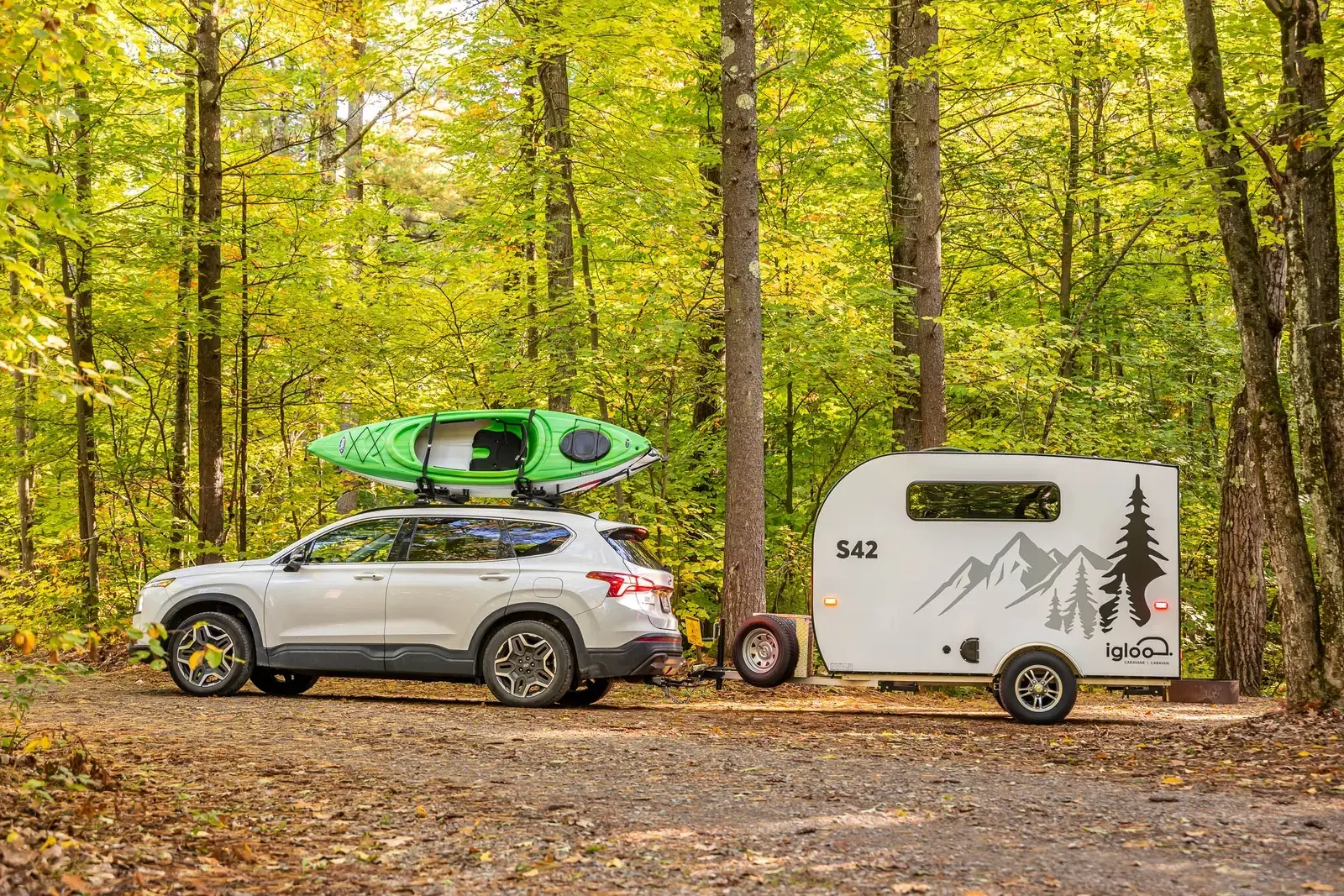
With a typical capacity of 680 kg, a small SUV can tow a teardrop or a stand-up mini-trailer like the S42, which reaches about 500 kg loaded. With the latter, the margin gets tighter: keep an eye on tongue weight and payload.
Electric or hybrid vehicle
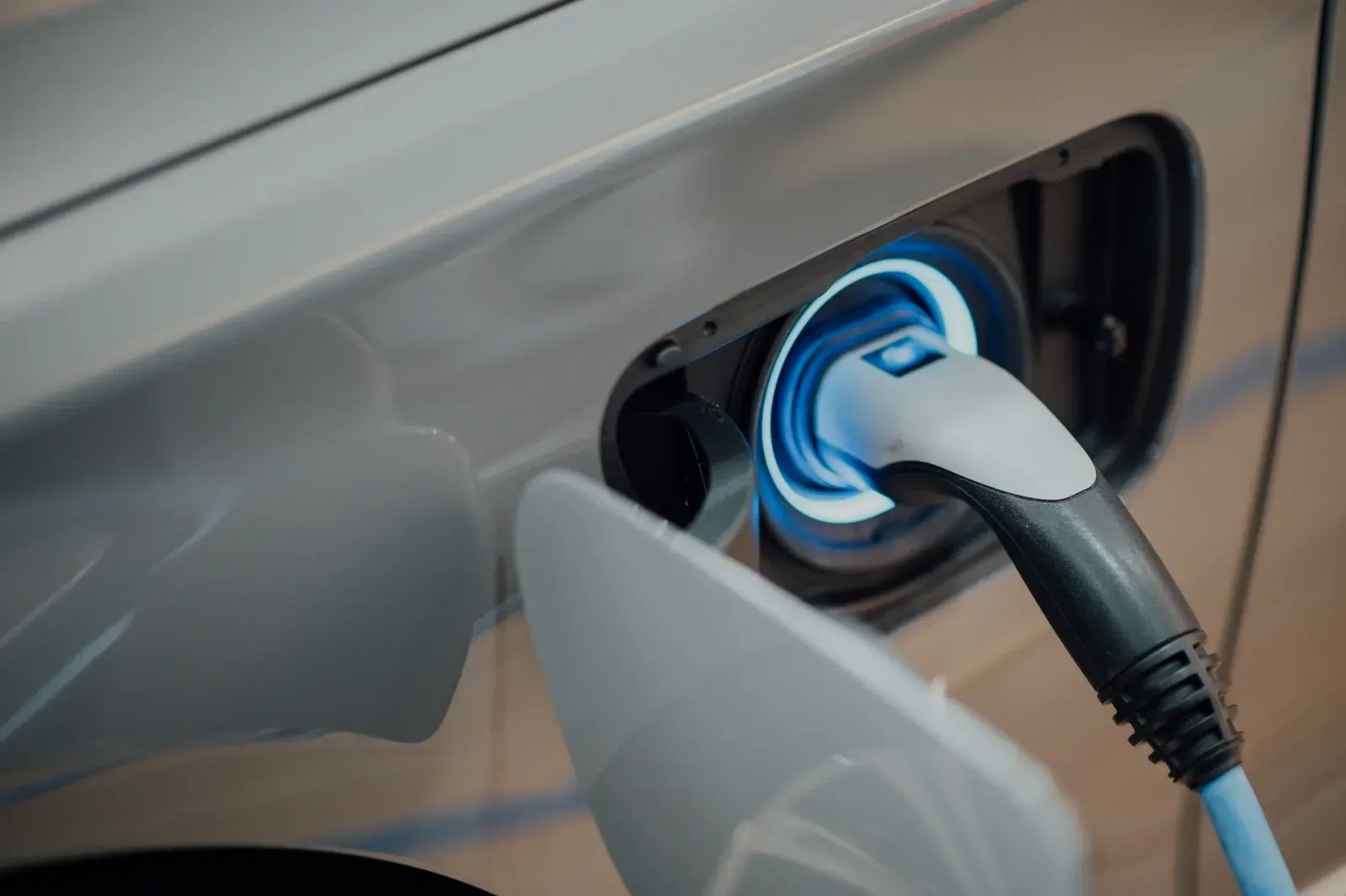
Several electric vehicles are approved for towing, but range drops as soon as a trailer is hitched. A low, narrow profile limits air resistance, and therefore the loss of range. Plan your charging stops accordingly, ideally at stations you can use without unhitching. An electric road trip then gets planned one charger at a time, the way you’d choose your lunch stops.
Not sure whether your car is compatible with a specific model? The manufacturer’s team can compare your vehicle’s specs with the expected loaded weight. Have your vehicle and trailer combination checked.
What the Highway Safety Code requires for hitching
Hitch and safety chains
The trailer hitch must be installed and used according to the manufacturer’s recommendations. Under the Highway Safety Code, sufficiently strong chains or a cable must prevent the vehicle and trailer from separating if the hitch breaks. Cross them under the tongue to form a cradle.
Mirrors and width
The mirrors must let the driver see behind the entire combination of vehicles. If the trailer is wider than the car, mirror extensions become necessary.
Width also matters for lighting. According to the ENPQ quick-reference guide, a vehicle or trailer more than 2 m wide must carry additional lamps, reflectors or flares. The two models mentioned above are 75 inches wide overall, or about 1.9 m.
Driving and braking
A vehicle towing a trailer is heavier and takes longer to stop, as CAA-Québec’s short guide to driving with a trailer points out. Increase your following distance, slow down before curves and practise reversing in an empty parking lot before your first trip.

Height and aerodynamics, two often-overlooked criteria
A trailer lower than the vehicle’s roof rides in its slipstream. It catches less crosswind, demands less effort from the engine and reduces fuel consumption. That’s the main advantage of the teardrop format: the T42 is 69 inches tall overall.
Conversely, a mini-trailer you can stand up in gains in comfort but has a larger frontal area. The S42 is 92 inches tall. With a small vehicle, you feel the difference mostly on the highway in strong winds and on long climbs, like the ones on the way to the parks of the Haute-Côte-Nord or the Gaspé Peninsula.
Confirm your vehicle’s towing capacity before you buy
For a mini-trailer for your vehicle, the check comes down to three numbers: the towing capacity, the vehicle’s net mass and the weight of the loaded trailer. The third must stay below the first, and below half the second to avoid having to put brakes on the trailer.
Then keep a margin for hills and luggage, and check the hitch, chains and mirrors before your first trip. The weights of the ultralight models are published on the mini-trailer models page, so you can run the numbers before you even visit.
Once the numbers check out, all that’s left is to pick your first destination: a lake in the Laurentians for the weekend, or the North Shore for two weeks on the road.
Spec sheet in hand and a few questions in mind? Get a recommendation tailored to your vehicle.
Frequently asked questions
How do you choose a mini-trailer for your vehicle safely?
To find a mini-trailer for your vehicle, write down three numbers: the towing capacity and the tongue weight limit from the owner’s manual, then the payload from the door label. Estimate the weight of the loaded trailer. It must stay below the capacity and below half the vehicle’s net mass; otherwise, trailer brakes are required.
Can a compact car tow a small trailer?
Yes, many compact cars can tow a small trailer, as long as the manufacturer allows towing. A teardrop like the T42, which weighs 220 kg empty, needs a capacity of about 300 kg once loaded and a net mass of at least 600 kg. Then install a compliant hitch with safety chains and adjust your mirrors to see behind the whole trailer.
Do you need a special licence to tow a mini-trailer in Quebec?
No, a Class 5 licence is generally enough to tow a mini-trailer with a car or SUV, since it lets you drive a two-axle vehicle with a net mass under 4,500 kg. The trailer must still be registered, lit and attached with chains. According to CAA-Québec, about four hours of lessons are enough to master the basics of driving with a trailer.